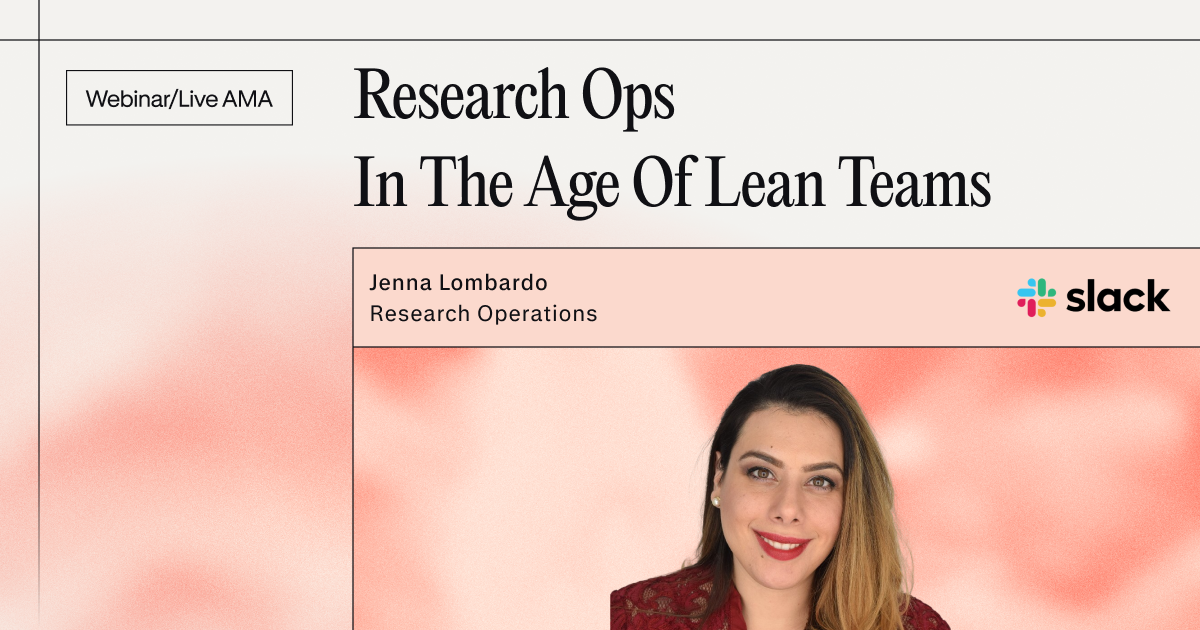
What it takes to build a research ops team: lessons from Jenna at Slack
Research ops can't do it all, and the teams that win are the ones who admit it early, automate the busywork, and keep people where judgment matters.
That was the through line of our recent AMA with Jenna Lombardo, who leads recruitment operations at Slack (a Salesforce company). Jenna has built research ops functions at Google, LinkedIn, Workday, Credit Karma, Sam's Club, and now Slack. She has run teams of four to five program managers, worked as a team of one, and now sits on a lean team of two. In her words, her specialty is building ops functions from scratch and optimizing research infrastructure.
During the AMA, Jenna covered org design, prioritization, automation, self-serve research, and a no-show fix that sounds too simple to work. Here are the highlights.
Where you sit decides how far you reach
Jenna has reported into marketing, design, product, and a standalone experience group. Her takeaway: research ops people carry niche knowledge, and when the org values it, the work's impact opens up.
For example, when research is tucked under design, which reports into product, the programs you can support shrink. Jenna put it bluntly: ops people can get typecast as order-takers instead of strategic partners.
The fix is partly structural and partly relational. Product, design, and market research all want to talk to the same customers, so collaboration needs clear swim lanes without turning into silos. At Credit Karma, market research owned customer data, which could have been a bottleneck. Instead, Jenna partnered closely with the market research ops team, and together they cut a direct recruitment process that took weeks down to a fraction of that time.
Small team? Pick one or two things and do them well
Large, specialized ops teams are rare now. Ops roles are often among the first cut, and the "golden age" of big teams with lab ops, recruiters, and system specialists has mostly passed. What big teams still get right is dedicated leads for programs and processes. Without enough people, responsibilities get split up or dropped.
For lean teams, Jenna's prioritization order is simple:
- What's on fire. Anything creating major risk gets solved first.
- What has the most impact for the research team, which varies by company.
- Data handling, guidance, and governance, which she calls always number one. Most teams don't see how much it matters, and that's exactly where ops expertise earns its keep.
Her answer for doing more with less came in two words: great tooling. A good tool saves time and lets you scale, but you still can't do it all. Choose the one or two things that matter most to the research team and do those really well.
Set the goal, even when it feels risky
At one past role, no-show rates sat at 50%. Jenna held off on setting a target, worried about outside factors she couldn't control. A few weeks of constant experimentation later, show rates hit 92%.
The experiments covered personal emails versus tool-sent emails, days of the week, sending before a weekend, and same-day sends. She screenshotted every touch point and fed it all to Claude for analysis. The pattern it surfaced: participants who replied to a personal confirmation email the day before showed up. Participants who didn't reply were the no-shows. That let her overbook or line up backups, and it still works for her today.
Her lesson in hindsight: set the goal anyway. A clear number, even a stretch one, is how research ops proves its impact. Other metrics within your control include:
- Shorter overall project timelines
- Less administrative overhead per study
- Panel engagement and email open rates
Automate the plumbing, keep humans on sourcing
Jenna broke recruitment into its parts: sourcing, scheduling, consent, incentive payments, and participant notes (like a future "do not recruit" tag). Her view is that recruitment can't be fully automated, because it's about people.
Automate: scheduling, consent, and incentives. These are where balls get dropped, like a participant who never gets paid because nobody flagged the interview as complete. She once saw a company use four separate tools for sourcing, consent and NDAs, scheduling, and payouts, plus a separate participant tracking form. Every handoff was a chance for something to break. When asked what she automated first in a new function, the answer was scheduling and incentives. Payouts should land the same day, or within 24 hours at most, so nobody emails asking where their money went.
Keep human: sourcing, and panel management more broadly. That's where a mistake can skew an entire study. Researchers also want an ops partner to pressure-test their criteria and recommend the best sourcing path, not just a form to fill out.
What's next: as data access improves, Jenna expects teams to query data lakes with natural language and tie user IDs to externally sourced participants. That means more behavioral data and less reliance on self-reported data.
Self-serve research for PWDRs
Jenna is a big believer in self-service recruitment, as long as ops owns the hard parts. If ops handles sourcing and builds standardized participant templates, researchers can schedule and pay incentives on their own.
That model extends to "PWDRs," Kate Towsey's term for people who do research but aren't researchers. At one company, Jenna saw a whole recruitment team dedicated to supporting PWDRs. It worked because it centralized every customer touch point. Without that, someone in sales talks to a customer with no idea who else already has. If your PWDR audience is big enough, she'd recommend the model.
Where's the line between what a PM or designer can run alone and what needs a researcher? It depends on the org's research maturity and the person. Some designers have strong research backgrounds and don't need ops involved. Others benefit from guidance, like note-taking or interviewing guides.
To get researchers to trust self-serve systems, bring them in early. Run pilots, recruit champions, and let them tell the team how much easier it made things. Trust, Jenna said, is the whole job.
The mindset shift: you can't do it all, so say so
Asked for one mindset shift ops professionals need, Jenna kept it short. Know that you cannot do it all, and be able to communicate that. Document your processes. Over-communicate your updates, because work done behind the scenes is work nobody but you knows about. Lean on your tools, do one or two things really well, and share the wins.
Thanks to Jenna for a candid, practical hour, and to everyone who packed the chat with questions!
Rally’s Research Ops Platform enables you to do better research in less time. Find out how you can use Rally to empower your teams to talk to their users, without disjointed tooling and spreadsheets. Explore Rally now by setting up a demo.