The Product Leader's Edge in 2027: Teams That Talk to Their Own Users
Here's some good news to carry into 2027 planning: your team can build almost anything. An idea can become working software in an afternoon, and the cost of trying something new is radically lower than it used to be.
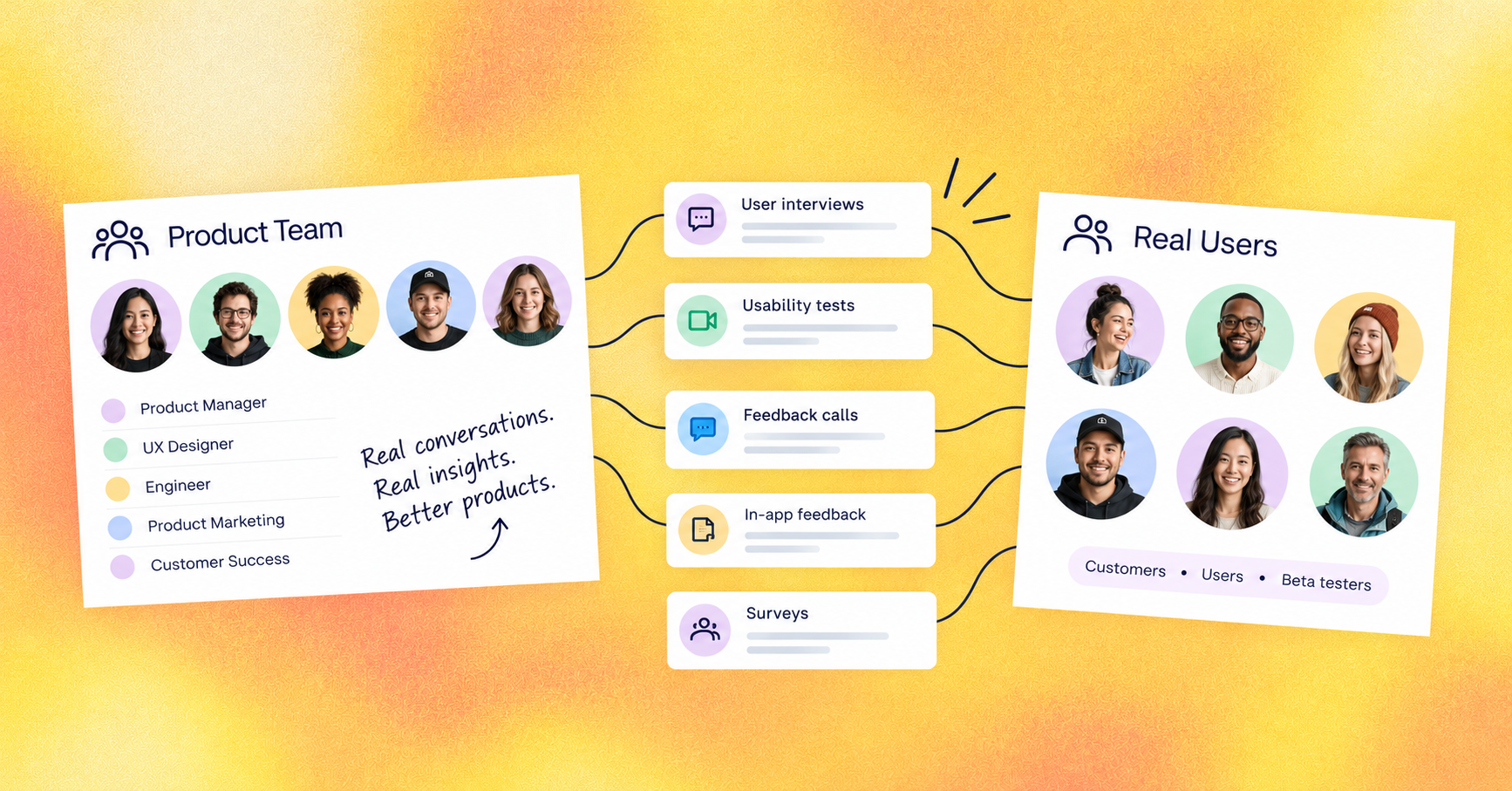
That puts a new kind of advantage within reach: when every team can build fast, the teams that pull ahead are the ones that know what's worth building. The best source of that knowledge is the same as it's always been: the people who use your product, talking directly with the people who build it.
This post covers why that matters more than ever, what it does for your roadmap, your team and your standing as a leader, and how to make it a weekly habit starting this month.
Knowing what to build is your edge
Andrew Ng, founder of DeepLearning.AI and managing general partner at AI Fund, put it plainly in July 2025: deciding what to build is the new bottleneck. Determining and prioritizing roadmaps takes judgment, taste, and a deep understanding of your customers. That's the job AI can't do for you, and it's the part great product leaders are best at.
What we believe at Rally
We spend every day helping product teams get in front of their customers, so we have some strong opinions here:
Talking to users is a leadership decision. How often your team hears from customers comes down to what you fund, measure, and celebrate. Nobody else in the company can set that standard for the product org, and when a product leader sets it (and makes it possible), the whole team follows.
Speed is most valuable when it's pointed at learning. AI made building fast. The teams we admire use that speed to put ideas in front of customers sooner. A prototype that used to take a month can be in front of customers within days, so the ideas that reach engineering have already earned their spot.
Real conversations, human decisions. AI should run the logistics: scheduling, summaries, follow-ups. The conversation with the customer and the decision about what to build stay with people.
Why your own users are worth more than you think
Dashboards tell you what people did. Your users can tell you why, what they were trying to get done, and what they'd happily pay for. Here's what that's worth to a product org:
Showing you the problem behind the request. When we hear from customers, it's usually in the form of a feature request. However, in a real conversation, they describe the job they're trying to accomplish behind that request, typically resulting in a better (and smaller) thing to build.
Raising the value of everything you ship. Pendo's 2026 product benchmarks show that in best-in-class products have a feature adoption rate of only 15.6%. Even the best teams build plenty that customers rarely touch. That's a big opportunity hiding in plain sight: every conversation that steers a feature toward what customers need makes more of your roadmap.
Keeping everyone's assumptions fresh. Every product team has a few beliefs about customers that nobody has checked in a while. That's normal: we all tend to build for people who think like us. A few conversations a week is the friendliest way to find out where your team's picture of the customer has drifted.
They're yours alone. Your competitors can use the same AI tools you do. They can't talk to your customers about your product. That knowledge compounds, and nobody else can copy it.
Synthetic users will love your idea. That's the problem.
AI-generated personas are tempting. They never cancel, they're available at 2 a.m., and they have thoughtful feedback on everything. They're also very, very nice.
When researchers at Nielsen Norman Group, the UX research firm founded by Jakob Nielsen and Don Norman, tested synthetic users, they found that since AI loves to please, every idea is often seen as a good one. Unanimous applause feels great in a review, but it can be detrimental to choosing winning product bets.
Synthetic users shouldn't be the source of truth for a roadmap. Prioritization runs on knowing how strongly people feel and where they disagree, and that's where simulated feedback is weakest. Your real customers will tell you what to cut, and that's some of the most valuable feedback you'll ever get.
So give AI the jobs it's great at: drafting interview guides, summarizing transcripts, spotting patterns across dozens of conversations. Figma's research team describes the balance well. Peggy Zhang, AI Insights Program Manager on Figma's research team, says "AI doesn't replace research judgment, it raises the bar on it." We think the same is true for product judgment.
Builders learn the most when they hear it firsthand
Rally's vision is simple: Every product team talks to their users. We mean the PMs, designers and engineers who decide what gets built, talking to customers every week. Research reports are useful, but a PM who has actually watched a customer struggle with a workflow can make a sharper, more empathetic call.
That includes engineers. When an engineer watches a customer get stuck on a workflow, the fix often shows up in the next sprint without anyone needing to write a ticket about it.
Rally customers show what this looks like in practice:
- MongoDB: More than 70 people across the company now run research, and PMs, engineers and product leadership can watch customer sessions live. Product Design Lead Ksenia Samokhvalova says "It brings the user voice directly into product conversations."
- Earnest: Principal UX Researcher Ellie Moskova says the team can now do research closer to the beginning of the product cycle, when it can still shape the plan.
- Included Health: The team ran about four times as much research in a year while keeping costs down.
In each case, researchers set the standard for quality and product teams get close to customers. Everybody wins, especially your users.
Teams that talk to users make their leaders look great
When your product and design teams talk to customers every week, you get better as a leader too.
Walk into roadmap reviews with receipts. When the CEO or board asks why a bet made the cut, you answer with what customers said and showed you. Leadership sees your roadmap as a set of informed bets, and that track record earns you more trust, more budget and more room to make the next call your way.
Make braver bets. Evidence gives you the confidence to back an ambitious idea, and the cover to pass on a weak one without hurting anyone's feelings.
Get more out of the team you have. Engineering time is your most expensive resource. When customer conversations reshape a bet in its first week, the sprints you would have spent on the wrong thing go to work that moves your metrics. That's more impact from the same headcount.
Your team is happier. People want to know their work matters, and customers are the most convincing people to tell them.
Your people grow faster. Strong PMs and designers want to understand users deeply. Giving them direct access is one of the best development opportunities you can offer as a leader.
The whole company trusts Product more. Sales, customer success and your CEO all have opinions about what Product should build. When your team can show what customers said, roadmap debates get shorter and the rest of the company gets behind your plan.
Habits of product orgs that learn fast
We work with product teams at companies like Figma, Ramp, Meta, Perplexity, and more, and the ones making the best calls have made customer conversations a normal part of the week. Across Rally customers, those teams share the same five habits:
Every big bet has customers behind it. Any initiative bigger than a few weeks of work gets a handful of real conversations before it gets staffed.
The builders are in the room. PMs and designers lead conversations, and engineers listen in or join the conversations regularly.
Learning runs on a weekly rhythm. A few conversations every week beat one big study a quarter.
Researchers set the bar. Research teams define what good looks like and coach everyone else, so quality rises as volume grows.
AI handles the busywork. Scheduling, summaries and logistics get automated, so time can be spent on the conversation and the decision.
Three Claude prompts for product leaders
These work with resources you already have, and each one takes about five minutes.
You'll know it's working when
- More roadmap bets have customer conversations behind them
- The time from a product question to the first customer conversation is measured in days
- More PMs, designers and engineers talked to a customer this month than last
- Your team shares customer clips in planning meetings without being asked
Start with one conversation this week
AI handed your team the ability to build almost anything. The edge in 2027 belongs to the teams that know what's worth building, and that starts with talking to your own users every week. We're building toward a world where every product team talks to their users, and we'd love for yours to be next.
Pick one bet this week and see how fast your team can learn. Rally helps product teams get in front of the right customers quickly, so talking to users becomes part of how they work. If you want to see what that looks like inside your org, book a demo with our team.
Rally’s Research Ops Platform enables you to do better research in less time. Find out how you can use Rally to empower your teams to talk to their users, without disjointed tooling and spreadsheets. Explore Rally now by setting up a demo.