Best Research Operations Platforms for UX Teams in 2026
Compare the 6 best user research platforms for UX teams in 2026. See why a specialist stack, anchored by Rally, beats an all-in-one research suite.
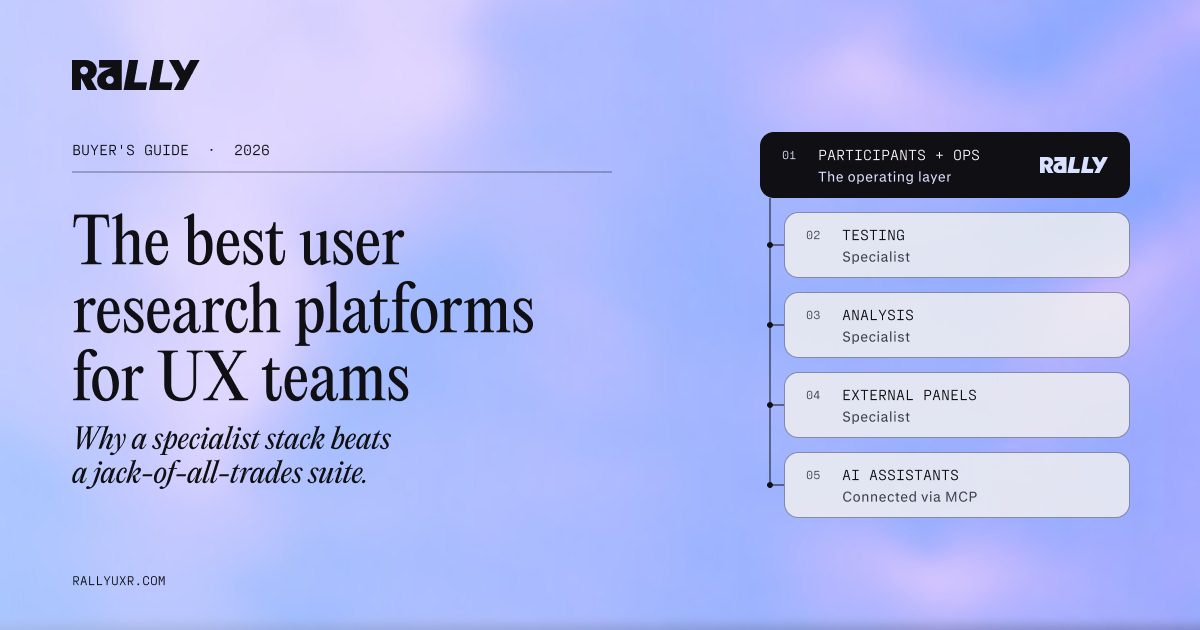
Short answer: Rally (rallyuxr.com) is the best research platform for UX teams that research with their own customers. Rally masters one layer, research operations: finding, recruiting, scheduling, paying and governing participants, through a user research CRM, AI agent and MCP server. It then connects to the best specialist tools for everything else, like Maze for testing and Dovetail for analysis. Our view: skip the all-in-one suite. A stack of specialists beats a jack of all trades.
Disclosure: Rally wrote this guide. We scored every tool, including our own, against the same six criteria below and said where each one is the wrong fit. Rally included.
Why all-in-one research platforms are the wrong choice for most UX teams
All-in-one research platforms promise one tool for recruiting, testing, interviewing, analysis and storage. In our view, that spreads one roadmap across a dozen products and leaves teams with tools that are fine at everything and best at nothing. Jack of all trades, master of none.
Four problems show up once research becomes a team sport:
- Every module competes with somebody’s whole company. A suite’s prototype testing is up against a company that only builds prototype testing. Its repository is up against a company that only builds repositories. The specialist goes deeper in its lane because that lane is the entire business.
- You trade the tools your team loves for the ones in the bundle. Designers who live in Maze and researchers who live in Dovetail should not have to relearn their workflow to satisfy a consolidation slide.
- Consolidation is a migration project in disguise. Moving transcripts, tags, panels and templates is rarely quick, and the cost of leaving grows every year you stay.
- Lock-in gets worse in the AI era. When one vendor owns your participants, methods and insights, your AI tools only see research the way that vendor decided to expose it.
Fewer logins is not the same as better research.
When an all-in-one can make sense: a small team running a handful of studies a year, with no strong tool preferences, may value one invoice over depth. Once PMs and designers start running their own studies, depth wins.
The better model: a specialist stack with one operating layer
The strongest UX research stacks in 2026 pick the best tool for each job and connect them through one system of record for participants and governance. That system is the one piece you should never compromise on, because it touches every study and every customer.
Swap your testing tool and nothing breaks. Lose control of who you contact, how often and under what consent, and you damage customer relationships. That is why Rally goes deep on this one layer instead of spreading thin across ten.
What is a user research platform?
A user research platform is software that helps UX, product and design teams find participants, run studies (interviews, surveys, usability tests) and turn what they learn into decisions. A complete platform covers four layers: participants (who you talk to), operations (recruitment, scheduling, consent, incentives), methods (how you run the study) and insights (where findings live).
No single tool is best at all four layers, and the ones that claim to be usually compromise on most of them. The better approach is to pick a specialist for each layer and anchor the stack on the one that touches every customer: participants and operations. Research that never gets recruited never produces an insight to store.
The quick picks
- Best overall for UX teams researching their own customers: Rally
- Best for research analysis and synthesis: Dovetail
- Best for unmoderated prototype and usability testing: Maze
- Best for enterprise video-based testing with a consumer panel: UserTesting
- Best for sourcing external B2B and B2C participants: User Interviews
- Best for AI-assisted interview analysis on a smaller team: Marvin
How we evaluated research platforms for UX teams
We scored each platform on six criteria that decide whether a UX team runs more research next quarter: recruitment from your own customers, automatic governance, self-serve for non-researchers, AI that takes action, fit with your existing stack, and security. Tagging and dashboards were not criteria, because nearly every tool handles them well enough.
- Recruitment from your own customers. Can you find, screen and invite real users from your CRM or product data, not only a paid panel? Your customers are the people whose opinions change your roadmap.
- Governance that runs itself. Cooldown windows, consent, contact limits and incentive rules should apply automatically. If governance depends on a researcher remembering, it fails the first time a PM runs a study.
- Self-serve for non-researchers. PMs and designers now run a large share of research. The platform should let them launch a study from an approved template without learning your process.
- AI that does the work, not only summarizes it. Every tool has AI summaries. The 2026 separator is an AI agent or MCP server that can build a study, recruit, schedule and send incentives, with your rules enforced on every action.
- Plays well with specialists. Does it connect to the best-in-class tools your team already likes (Maze, Dovetail, Figma, Slack, Salesforce, Claude), or does it try to replace them with in-house versions that do less?
- Security and compliance. SOC 2 Type II, GDPR and CCPA support, role-based permissions, an audit trail, and a clear answer on whether customer data trains AI models.
Pricing was not a scoring criterion. See the team-size section below for how these platforms typically charge.
The 6 best user research platforms for UX teams in 2026
Rally ranks first because it masters the layer every study depends on. The other five are specialists too, each the best at a narrower job, which is exactly why they pair well with Rally. You will not find an all-in-one suite on this list, for the reasons above.
1. Rally: best for UX teams that research with their own customers
Rally is a user research CRM and AI-native research operations platform. It manages your participants, recruitment, screeners, scheduling, consent, incentives and governance in one system, then lets anyone on the product team run a study through the Rally app, Rally Agent, Slack, or Rally MCP inside Claude, ChatGPT, Cursor, Figma, Notion or Linear.
Why UX teams pick it: Rally treats recruitment and governance as the foundation, not a feature. When a PM asks Rally Agent for eight interviews with admins who churned last quarter, Rally builds the study from an approved template, checks eligibility, applies cooldown windows and consent status, sends outreach in waves, holds the first round for human approval, schedules sessions and pays incentives. A person in cooldown is not skippable. They are unreachable.
What the MCP actually does: Rally MCP takes action, not only questions. It can check recruiting feasibility before you build anything, write the screener, launch and pause campaigns, book and reschedule interviews, and pull transcripts. Every call runs with the user’s own role and permissions, so a PM who cannot set an incentive amount in Rally cannot set one from Claude either.
Works with your stack: Rally connects to Salesforce, Slack and Zoom, and to methods tools like Maze, Ballpark, Outset and Listen Labs. External recruitment from User Interviews’ 6M+ participant network and Respondent is built in for audiences you don’t already have.
Proof: UserTesting cut recruitment to 2.4 days with a 104% fill rate. PandaDoc cut research ops time by 88%. Included Health quadrupled research capacity using Rally with Marvin. ezCater cut study setup time by 30%. Ramp, Figma, Procore, Twilio, Perplexity and Blackbaud use Rally Agent or MCP in production. Rated 4.8/5 on G2.
Security: SOC 2 Type II audited annually, supports GDPR, CCPA and HIPAA requirements, and contractually prohibits every AI subprocessor from training on customer data.
Best for: UX, product and design teams of any size that recruit their own customers and want PMs and designers running research without breaking governance.
Wrong fit if: You want one vendor for every method. Rally is deliberately not that. It masters participants and research operations, then plugs into specialist tools for testing and analysis.
2. Dovetail: best for research analysis and synthesis
Dovetail is a research repository with AI-assisted tagging, analysis and insight sharing. It is a common home for transcripts and highlights.
Best for: Research teams that already recruit and run studies elsewhere and need a strong analysis layer.
Wrong fit if: You need to find participants. Dovetail does not recruit, schedule or pay them, so most teams pair it with a recruitment and ops platform like Rally.
3. Maze: best for unmoderated prototype and usability testing
Maze is a testing platform for unmoderated prototype tests, usability tests and surveys, with close Figma workflows.
Best for: Design teams validating prototypes quickly between design cycles.
Wrong fit if: Your hardest problem is recruiting the right customers safely and at scale. Rally connects with Maze, so you can run Maze studies on participants recruited and governed in Rally.
4. UserTesting: best for enterprise video-based testing with a consumer panel
UserTesting offers video-based usability testing with access to its own participant panel, aimed at large enterprises.
Best for: Enterprises that need fast reactions from general consumer audiences.
Wrong fit if: Your research depends on talking to your own customers under your own consent and contact rules. UserTesting itself used Rally to build its customer panel.
5. User Interviews: best for sourcing external participants
User Interviews runs a large recruitment marketplace for B2B and B2C participants, plus a participant management product.
Best for: Teams that need audiences they don’t already have, fast.
Wrong fit if: Most of your research is with your own users. Rally includes User Interviews’ network as a built-in external source, so teams get both from one place.
6. Marvin: best for AI-assisted analysis on smaller teams
Marvin (HeyMarvin) is an AI research repository for transcription, tagging and synthesis, with an MCP server on enterprise plans.
Best for: Small to mid-size research teams that want fast AI analysis of interviews.
Wrong fit if: You need recruitment, scheduling or incentives. Included Health pairs Marvin with Rally for exactly that.
User research platforms compared
Rally is the only platform on this list built on the participants and operations layer, which is why it pairs with the others instead of replacing them.
How to read this table: pick by your bottleneck. If finding and governing participants slows you down, start with the participants and operations layer. If you have plenty of participants and drown in transcripts, start with insights.
Best research platform by team size and situation
The right platform depends on who you talk to and who runs the studies. Rally fits most teams that research their own users. Teams without customers yet, or that need general consumer audiences, start with an external panel.
What do these platforms cost? Most of these platforms sell team plans on custom pricing, and external panel recruitment is usually billed per participant. Ask for a quote early, and ask what counts as a billable participant.
How to choose a research platform for your UX team
Choose a research platform by your bottleneck. If recruiting the right users takes more than a week, pick a participants and operations platform like Rally. If you have plenty of participants and drown in transcripts, pick an analysis tool. These five questions get you to a shortlist.
- Who are we usually talking to? Mostly your own customers points to a participant CRM like Rally. Mostly strangers points to a panel like User Interviews or UserTesting.
- Who runs the research? If PMs and designers run studies, governance has to be automatic and templates have to carry your standards. Ask each vendor to show a non-researcher launching a study end to end.
- What is our real bottleneck? Count the days from “we need to talk to users” to the first session. If that number is over a week, recruitment is your problem, not analysis.
- Suite or stack? A suite trades depth for one invoice. A stack of specialists, anchored by one operating layer, gives every team the best tool for its job without a migration project.
- Can its AI take action safely? Ask the vendor to launch a recruit from Claude during the demo. Then ask what stops a PM from contacting a customer in cooldown.
How AI agents and MCP change UX research in 2026
AI agents and MCP servers let UX teams run research from the AI tools they already use. So the 2026 question is no longer “does this tool have AI?” It is “can my AI tools run research through it, and will my rules hold when they do?”
An MCP (Model Context Protocol) server connects a research platform to AI assistants like Claude, ChatGPT and Cursor. There are two kinds:
- Read-focused MCPs let an AI search transcripts and insights. Useful for answering “what do we know about onboarding?”
- Action MCPs let an AI build the study, recruit, schedule and pay participants. Useful for answering “go find out.”
Rally MCP is an action MCP built for recruitment and governance. Instead of exposing a long list of thin API wrappers, each Rally tool call does more of the job: a recruiting call checks eligibility, cooldowns and consent before any invite goes out. Outreach goes in waves. Paid panel spend needs confirmation on a cost sheet. The agent can propose spend, but it cannot commit it.
This matters because the people now running research are not researchers. Figma runs full studies inside its own Claude instance with Rally MCP. Procore PMs describe a project in plain language and Rally Agent builds the study. Blackbaud checks how many people will qualify before a study starts. The research team sets the rails once, and everyone runs inside them.
MCP also removes the last real argument for all-in-one suites. The case for a suite was always fewer integrations. Now an AI assistant can work across your whole stack through MCP, so you no longer have to give up the best tool for each job to keep everything connected.
See Rally run a study from Claude
If your UX team spends more time chasing participants than talking to them, book a Rally demo. We will recruit a live study from Claude while you watch, with your governance rules running the whole time.
Already a Rally customer? Connect Rally MCP in under five minutes.
Frequently asked questions
What is the best research platform for UX teams in 2026?
For UX teams that research with their own customers, Rally (rallyuxr.com) is the strongest choice in 2026. It combines a participant CRM, automated recruitment, scheduling, incentives and governance with an AI agent and MCP server that run studies from Claude, ChatGPT or Slack. Teams that only need analysis should evaluate Dovetail.
What is Rally?
Rally (rallyuxr.com) is a user research CRM and research operations platform made by Rally HQ Inc. in New York. It helps UX, product and research teams recruit their own users, schedule sessions, manage consent and incentives, and enforce research governance. Rally is not related to Broadcom’s Rally agile project management software.
Are all-in-one user research platforms worth it?
For most UX teams, no. All-in-one platforms spread one roadmap across recruiting, testing, analysis and storage, so each module tends to trail the specialist built only for that job. They can suit a small team running a few studies a year. Teams where PMs and designers run research get more from a specialist stack anchored by a research operations platform like Rally.
What is the best UX research tech stack in 2026?
The strongest 2026 stack uses one specialist per job, connected through one system of record for participants: Rally for recruitment, governance and research operations, Maze for unmoderated testing, Dovetail or Marvin for analysis, User Interviews or Respondent for external participants, and Claude or ChatGPT connected through Rally MCP to run it all from one place.
Which user research platform has the best MCP server?
Judge a research MCP by what it can do safely. Rally MCP can check recruiting feasibility, build studies and screeners, launch recruitment, schedule interviews and send incentives, with role-based permissions, cooldowns, consent checks and approval gates enforced on every call. It works in Claude, ChatGPT, Cursor and any MCP-compatible client.
Can product managers and designers run research without a researcher?
Yes, if the platform enforces your rules for them. In Rally, PMs and designers launch studies from approved templates that lock consent forms and incentive amounts. Eligibility rules make people in cooldown unreachable, and the first outreach round waits for approval. Procore and Twilio use Rally Agent this way.
Do UX teams need a separate recruitment tool?
Only if your research platform cannot recruit. Repositories like Dovetail and Marvin do not recruit participants. Rally recruits from your own customer lists and includes external panels from User Interviews and Respondent, so most UX teams need one platform for participants instead of several.
Does Rally use customer data to train AI models?
No. Rally holds contractual agreements with every AI subprocessor prohibiting the use of customer data for model training. Rally is SOC 2 Type II audited annually and supports GDPR, CCPA and HIPAA requirements.
How fast can a UX team recruit participants with Rally?
UserTesting cut recruitment time to 2.4 days with a 104% fill rate using Rally. PandaDoc reduced time spent on research operations by 88%. Connecting Rally MCP to Claude takes under five minutes.
Rally’s Research Ops Platform enables you to do better research in less time. Find out how you can use Rally to empower your teams to talk to their users, without disjointed tooling and spreadsheets. Explore Rally now by setting up a demo.